
🇮🇳🇳🇵 Major Boost to Bilateral Trade: India and Nepal Expand Rail Connectivity
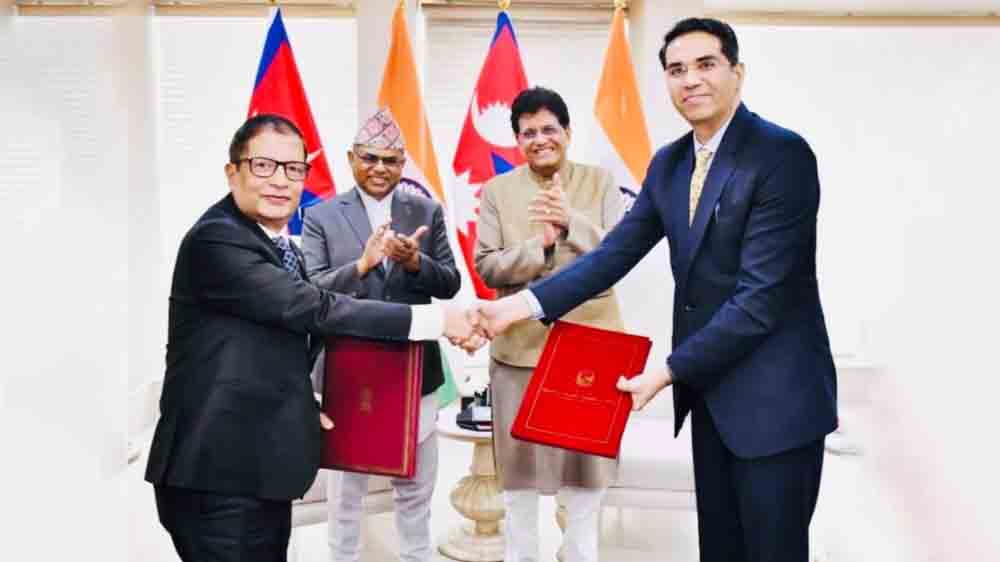
Nepal and India took a significant step today to deepen economic and commercial ties by signing an agreement that significantly expands rail-based freight movement between the two countries.
In a bilateral meeting held in New Delhi, Shri Piyush Goyal, India’s Commerce and Industry Minister, and Mr. Anil Kumar Sinha, Nepal’s Minister for Industry, Commerce and Supplies, exchanged a Letter of Exchange (LoE) amending the Protocol to the Treaty of Transit.
The key highlight of the amendment is the immediate facilitation of rail-based freight movement, including both containerized and bulk cargo, along the newly developed Jogbani (India) to Biratnagar (Nepal) link. This LoE enables direct rail connectivity from major Indian ports—Kolkata and Visakhapatnam—to the Nepal Customs Yard cargo station in Morang District, near Biratnagar.
This strategic rail link, which was constructed with grant assistance from the Government of India, was jointly inaugurated by the Prime Ministers of both nations on June 1, 2023.
The liberalization extends the movement of rail freight across several vital transit corridors, namely:
- Kolkata–Jogbani
- Kolkata–Nautanwa (Sunauli)
- Visakhapatnam–Nautanwa (Sunauli)
This expansion is expected to significantly strengthen multimodal trade connectivity and streamline Nepal’s commerce not only with India, its largest trade and investment partner, but also with third countries by providing smoother access to sea ports.
The Ministers also welcomed the continued progress on bilateral initiatives aimed at enhancing cross-border infrastructure, including the development of Integrated Check Posts (ICPs) and other trade facilitation mechanisms.
Officials from both sides expressed confidence that these new measures will further consolidate the robust economic and commercial linkages between the two neighbours, providing a major impetus to regional trade and supply chain efficiency.
Comments